

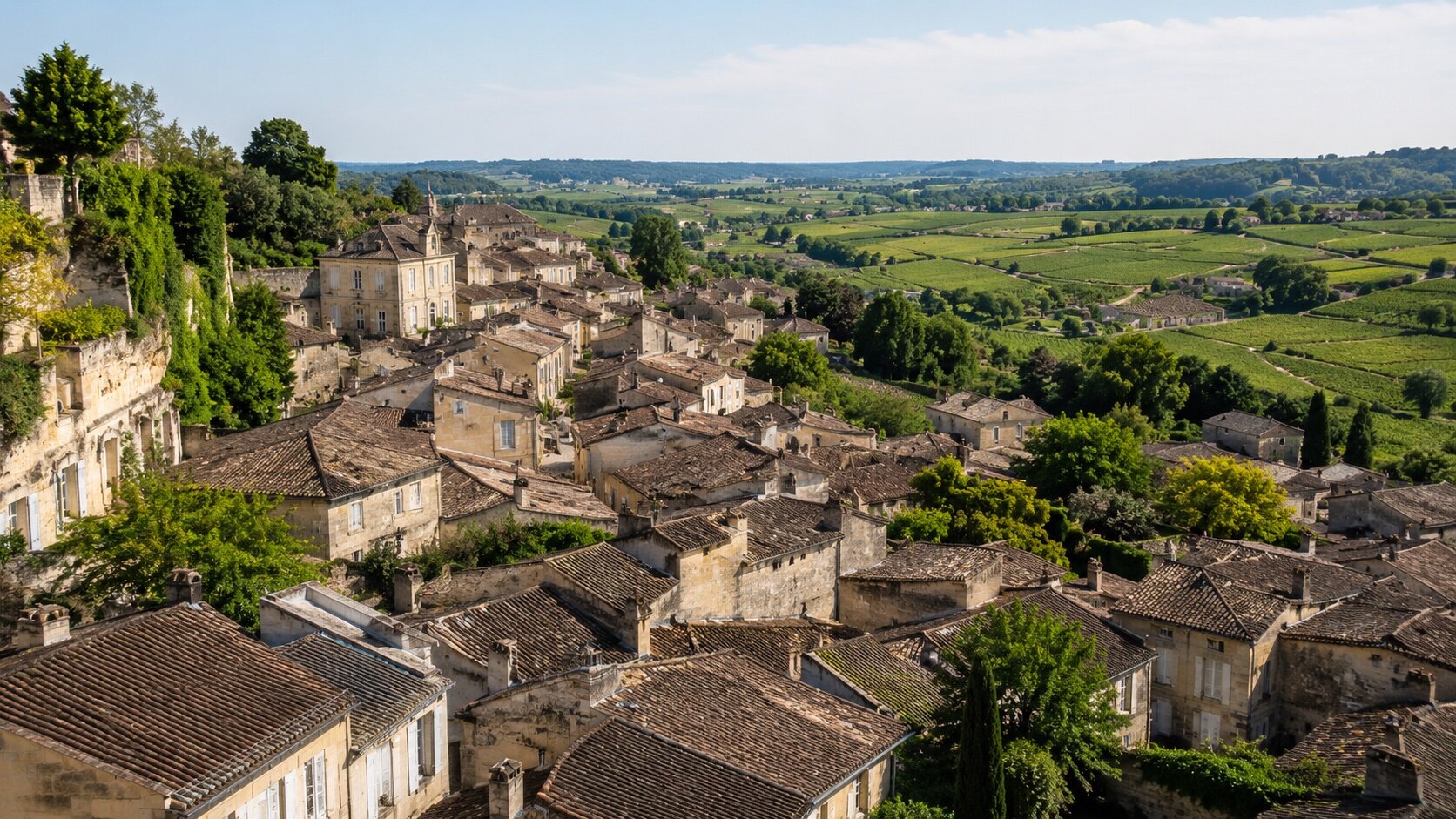
About an hour from our estate, Saint-Émilion offers a day of exploration through its medieval town, historic monuments, vineyards, and UNESCO-listed heritage sites. October is the perfect time to stroll through the narrow streets and fully enjoy the vineyard-dotted landscapes surrounding the village.
From our property in Mazion, we invite you to Visit Saint-Émilion in October 2026 to explore one of the most famous wine-growing villages in Gironde. This getaway offers a change of scenery while still keeping you immersed in the world of the Bordeaux vineyards. You can explore the medieval town, discover its main monuments, take in the view of the vineyards from the village’s highest points, and spend a full day at this destination before returning to our estate near Blaye.
Why visit Saint-Émilion?
Saint-Émilion brings together in a single space Heritage, Architecture, and Wine Culture. The Saint-Émilion Wine Region has been listed as a UNESCO World Heritage Site since 1999. It encompasses eight municipalities and constitutes a cultural landscape shaped over several centuries by viticulture. UNESCO highlights, in particular, the continuity of winemaking activity as well as the rich history of the region’s villages and monuments. View the official UNESCO presentation.
Strolling through the narrow streets of the medieval city
A tour of Saint-Émilion naturally begins on foot. The village is spread out over several levels, and its terrain plays a major role in defining its character. The cobblestone streets, stairways, and sloping paths—known as “tertres”—lead to the main landmarks and several squares in the historic center.
We recommend setting aside enough time to explore without a overly packed itinerary. The limestone facades, narrow alleys, and views of the vineyards make up a large part of the appeal of this walk. The Porte Brunet, the Porte de la Cadène, and the remains of the old fortifications also serve as reminders of the village’s medieval layout.
The terrain can be rugged in some places. Good shoes are therefore recommended, especially in October when the cobblestones may be wet.
Discover the monolithic church of Saint-Émilion
One of the village’s most distinctive landmarks is located beneath the main square. The’Monolithic Church of Saint-Émilion is entirely carved out of limestone. The Grand Saint-Émilionnais Tourist Office states that it was built in the early 13th century and that it can be visited as part of guided tours.
Exploring the underground spaces also provides access to several sites associated with the town’s religious history, including the Émilion Hermitage, the Trinity Chapel, and the catacombs. These spaces offer a better understanding of how the village developed around limestone and the local religious tradition.
Above the church, the bell tower is the highest point in Saint-Émilion. It was built between the 12th and 15th centuries and, when open to the public, offers a panoramic view of the village and the surrounding vineyards. To find out the opening hours, we recommend that you check directly with the Grand Saint-Émilionnais Tourist Office before you travel.
Climb up to the Tour du Roy
The Tour du Roy is another major landmark in Saint-Émilion. This medieval keep overlooks the town and offers an unobstructed view of the village rooftops and the vineyards. The official guide published by the Tourist Office describes this monument as a 13th-century square keep accessible via 118 steps.
Explore the Collegiate Church and its cloister
The Collegiate Church of Saint-Émilion rounds out the tour of religious heritage sites. Built between the 12th and 15th centuries, it is one of the most important buildings in the historic center. Its cloister offers a quieter space, right next to the village’s main streets. The Tourist Office notes that the building once housed a community of Augustinian canons.
Take in a UNESCO-designated wine-growing landscape
Saint-Émilion is more than just its historic center. The vineyards are an essential part of its identity. UNESCO describes the Jurisdiction of Saint-Émilion as a historic landscape dedicated to viticulture, where winemaking has shaped the architecture, the villages, and the organization of the territory. The inscribed area covers 7,847 hectares.
This wine-growing aspect creates a natural connection to our own operations at Château Gigault. Our estate is located within the Blaye Côtes de Bordeaux appellation, on another part of the right bank. A day in Saint-Émilion thus offers the chance to discover another Bordeaux terroir while keeping wine as the central theme of the visit.
To continue this exploration when you return, we also offer Tours and tastings at our estate near Blaye, during which we showcase our vineyard, our work, and our wines.
Plan a day trip to Saint-Émilion from our estate
For a well-rounded excursion, you can spend the morning exploring the medieval center and the underground sites, then continue in the afternoon with a stroll through the village and its surroundings. Spending a full day there means you won’t have to rush from one sight to the next, leaving you more time to take in the scenery.
Our charming vacation rental near Blaye allows you to extend your stay right on the property. This way, you can alternate between days spent on excursions and quieter moments in the heart of our vineyard.
A trip between Saint-Émilion and the Blayais region
Visiting Saint-Émilion allows you to explore more of the Bordeaux wine region while using our estate as your starting point. The contrast between the medieval town of Saint-Émilion, the landscapes of the Blaye region, and the Gironde estuary allows you to discover several facets of the region during a single stay.
From Mazion, we also invite you to explore Blaye, Saint-Genès-de-Blaye, and the neighboring wine-growing towns. Our page dedicated to Our trip to the Bordeaux wine region provides a broader overview of this way to explore the region, encompassing its heritage, landscapes, and wine culture.
FAQ
What to See in Saint-Émilion?
You can explore the monolithic church, the Tour du Roy, the Collegiate Church, the medieval alleyways, the hillocks, and the main viewpoints overlooking the vineyards. The village is particularly well-suited for exploring on foot.
Is Saint-Émilion a UNESCO World Heritage Site?
Yes. The Saint-Émilion Wine Region has been inscribed on the World Heritage List since 1999 for the historical significance of its vineyard landscape and the continuity of viticulture in this area.
Can we visit the monolithic church?
The monolithic church is open to the public as part of guided tours, with hours that vary depending on the season. We therefore recommend that you check availability with the Tourist Office before your visit.
How much time should you set aside to explore Saint-Émilion?
One day is enough to explore the historic center, visit several monuments, and take the time to enjoy the vineyards. A half-day is also an option if you’d like to focus solely on the main attractions.
Where should you stay when visiting Saint-Émilion and the Blayais region?
Our vacation rental at Château Gigault in Mazion lets you stay right on a vineyard estate and plan several excursions in the Gironde. You can spend a day exploring Saint-Émilion, then devote the rest of your stay to Blaye, the estuary, and the wine-growing towns surrounding our property.